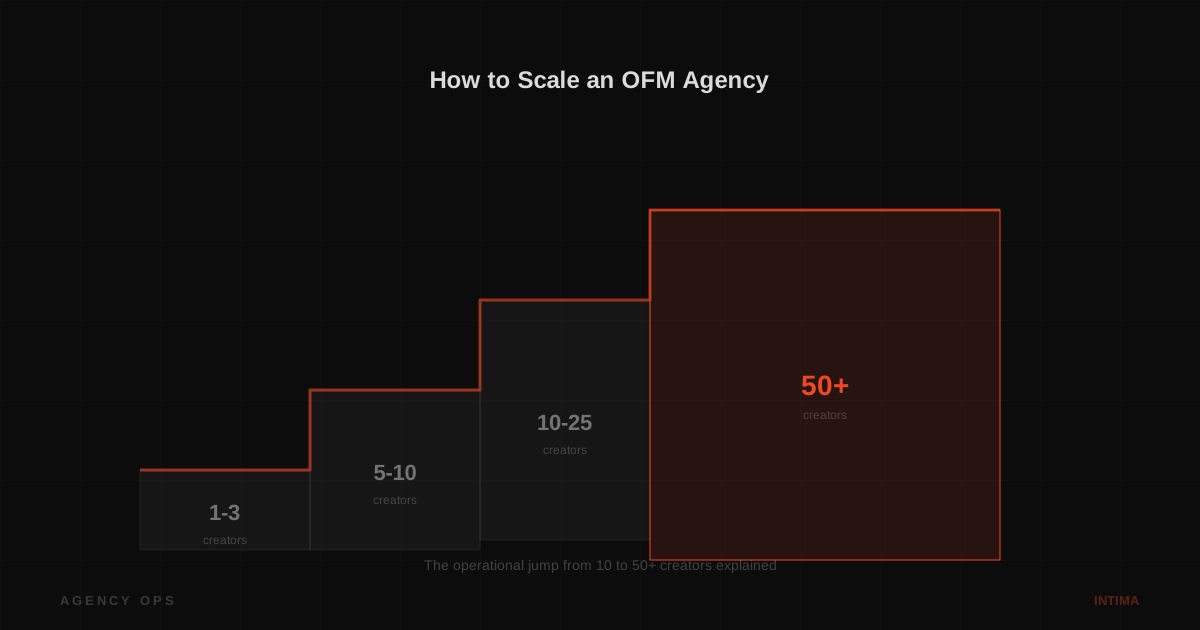
Most OFM agencies hit a ceiling between 5 and 15 creators. The founders are doing too many jobs at once, quality is inconsistent between accounts, and adding another creator feels like adding another point of failure. This post is about the operational fixes that let you scale without burning out.
If your chatting team is the bottleneck, see white-label chatting for agencies. If you want to compare building in-house vs outsourcing, see in-house vs outsourced chatters.
The three bottlenecks that stop agencies at 10 creators
Almost every OFM agency hits the same three problems at the same time:
- Chatting capacity: You can't add creators without adding chatters, and hiring, training and managing chatters is its own full-time job
- Inconsistent quality: The founder who was doing everything is now supervising people who weren't trained well enough to maintain the same standard
- No separation of roles: The same person is talking to creators, managing chatters, reviewing numbers and handling support issues simultaneously
The solution to all three is the same: specialize and outsource. But the order matters.
Outsource chatting before you hire internally
Internal chatters require hiring, training, managing, scheduling and quality control. All of that is true even before you have enough creators to justify a full-time chatter. A white-label chatting partner handles all of that for you and costs only when you have revenue to cover it.
The question is not "is it cheaper to do it ourselves?" The question is "what would it cost us in time and mistakes to build the chatting infrastructure from scratch?" For most agencies, the answer is more expensive than outsourcing, especially in the first 12 months.
Intima works with agencies on a 15% to 20% net model. See the full pricing breakdown for context.
What to standardize before you scale
Before adding more creators, standardize what good looks like on a single creator. That means a defined onboarding checklist (what you collect, what you build, what you approve before going live), a weekly reporting template (what numbers you share, when) and a quality review process (who checks chats and how often).
Adding creators to an undefined process multiplies the mess. Adding them to a defined process multiplies the system.
The creator-facing role vs the operations role
At small agencies, one person does both. At growing agencies, someone needs to own each. The creator-facing role handles relationships, reporting calls and creator expectations. The operations role owns chatting quality, response time and the numbers. When one person does both badly, you lose creators. When they're split, each gets done properly.
This separation doesn't require two full-time employees immediately. It requires two sets of responsibilities with one person clearly owning each, even if it's part-time at first.
Reporting that keeps creators from churning
The most common reason agencies lose creators is not bad results. It's creators who can't see the results and assume the agency isn't doing anything. A weekly report that shows response time, PPV unlock rate, revenue compared to the previous week and any notable fan conversations keeps the creator informed and invested.
A creator who understands what's happening in their account is less likely to look for alternatives. A creator who receives no reporting is a creator who's already thinking about it.
Hiring your first team lead
When you have five or more creators and outsourced chatting, your next hire should be a team lead or account manager whose job is to own the relationship with the chatting partner and with each creator. This person is the quality layer between you and both sides.
FAQ
White-label chatting for your agency
We handle the inbox. You handle creator relationships and growth.
See how it works →